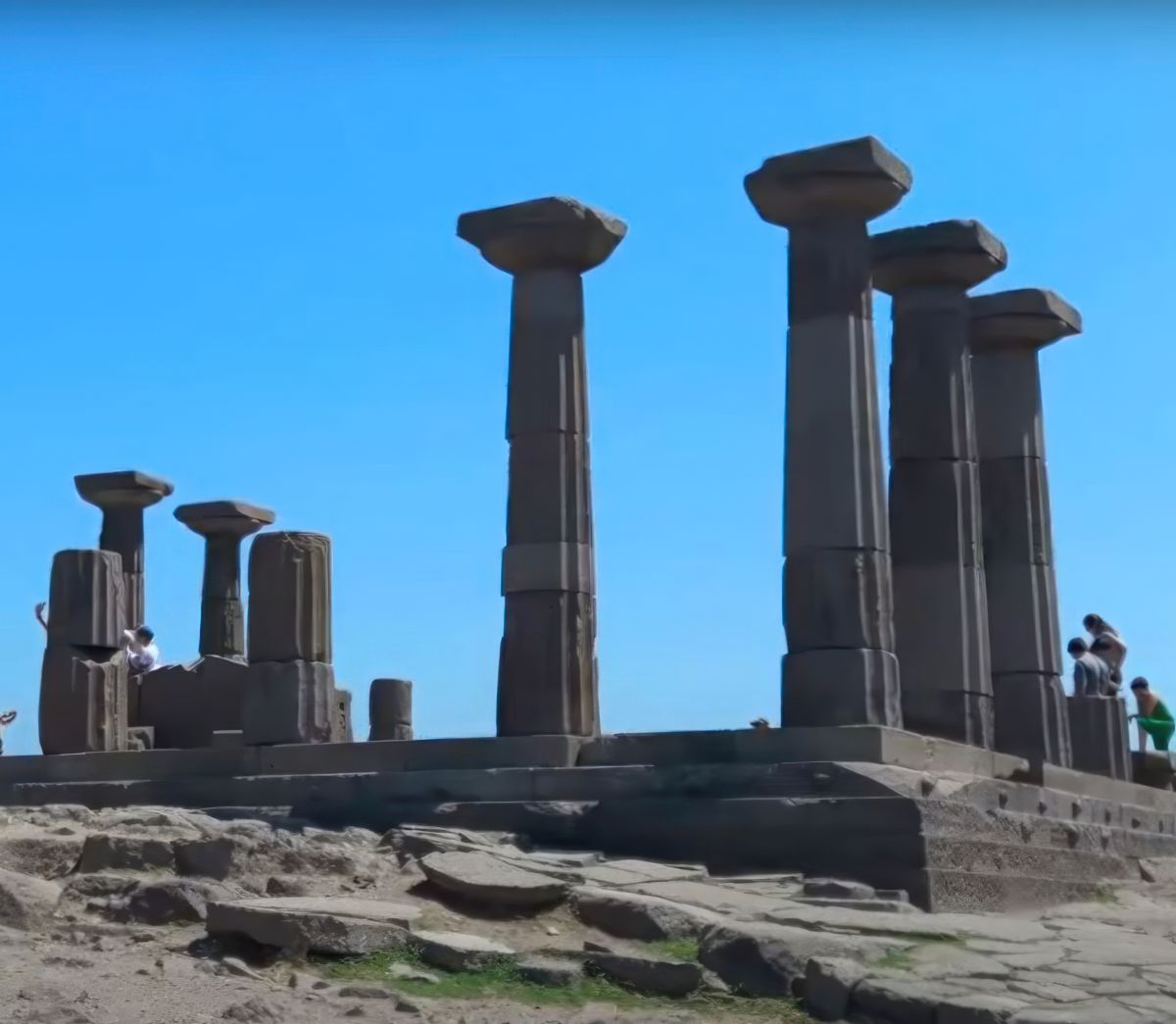
Assos (Behramkale), Ayvacık
Overview
Assos, officially known as Behramkale, is one of the most evocative historical sites in north-western Turkey. Located in the Ayvacık district of Çanakkale Province, it lies on the southern edge of the Biga Peninsula, within the ancient region known as the Troad. Assos is both an outstanding archaeological site and a much-loved seaside destination, where ancient ruins overlook a tranquil fishing harbour and the deep blue waters of the Aegean.
Although its official name is Behramkale, the settlement is almost universally known as Assos, reflecting its ancient identity and long association with classical history.
Two Faces of Assos
Assos is best understood as having two distinct but closely connected parts:
- the ancient city and acropolis high on the hill
- the harbour village below, clustered around a small, natural bay
Together, they form a rare and striking combination of monumental archaeology and living coastal village life.
Setting and Landscape
Assos occupies a dramatic natural position. The ancient city stands on a steep volcanic hill rising to 238 metres above sea level, commanding sweeping views of the Aegean. From the summit, visitors can see the island of Lesbos (Midilli) to the south, the rugged coastline stretching away in both directions, and the harbour far below with its distinctive turquoise waters.
This commanding vantage point helps explain why Assos was such a powerful and strategically important settlement in antiquity.
Origins and Ancient History
Assos was founded in the 7th century BC by Aeolian settlers from Lesbos, who recognised the site’s natural defensive strength and maritime importance. The city developed into a significant urban centre, fortified by massive stone walls, parts of which still survive today.
At the heart of ancient Assos stood the Temple of Athena, built in the 6th century BC at the highest point of the acropolis. This Doric temple dominated both the city and the surrounding sea routes, serving as a symbol of Assos’s power and prestige. From this point, one gains a powerful sense of how magnificent the city must have appeared at its height.
Assos and Philosophy
Assos holds a unique place in the history of philosophy. In the 4th century BC, the city became closely associated with Aristotle, who lived and taught here for several years. During his time in Assos, Aristotle founded a philosophical school and carried out important work before later returning to Macedonia to tutor Alexander the Great.
Near the entrance to the archaeological site today, visitors will see a large statue of Plato, the teacher of Aristotle, commemorating the city’s deep connection to classical thought and learning. This intellectual legacy sets Assos apart from many other ancient cities in the region.
Roman, Byzantine and Later Periods
Under Roman rule, Assos continued to flourish as a regional centre. Over time, however, its importance declined, and by the Byzantine period the city had largely contracted. Stones from ancient buildings were reused in later structures, a common practice throughout the region.
Despite periods of decline, Assos was never completely abandoned, and its strategic position ensured continued occupation in various forms.
The Ottoman Period and Behramkale
During the Ottoman era, the settlement became known as Behramkale. An important surviving monument from this period is the mosque built by Sultan Murat I (Murat Hüdavendigâr) in the 14th century, located near the ancient site. This mosque is well worth a visit and provides a striking contrast to the surrounding classical ruins, highlighting the continuity of settlement and faith on the same hilltop over many centuries.
Nearby, the Murat Hüdavendigâr Bridge, dating from the early Ottoman period, stands as another reminder of the region’s strategic importance and the Ottoman investment in infrastructure and transport routes linking inland settlements with the coast.
The Harbour of Assos
Below the ancient city lies the harbour of Assos, one of the most charming and atmospheric small ports on the Aegean coast. The ancient harbour forms a sheltered inlet, now lined with fishing boats, small restaurants, cafés and gift shops.
The harbour area also features a small beach, suitable for swimming, and a number of well-regarded hotels that make it possible to stay right by the sea. The combination of historic stone buildings, calm waters and simple harbour life creates an idyllic setting for visitors seeking both relaxation and character.
Visiting the Archaeological Site
The walk up to the ancient site from the village is steep but rewarding. Along the path, visitors will find village stalls selling handmade items, clothing and souvenirs, adding to the sense of a living settlement rather than a purely museum-like site.
The ruins themselves are extensive and include:
- the Temple of Athena
- sections of the city walls
- remnants of the agora, theatre and residential areas
Restoration and conservation work continues, ensuring that Assos remains accessible while preserving its historical integrity.
Kadırga Cove
Just two kilometres from Assos, along the coastal road, lies Kadırga Cove, a beautiful natural bay surrounded by old olive trees. The beach here is wide and sandy, with clear, clean water, and has been awarded Blue Flag status. Kadırga is popular with both locals and visitors and provides an excellent contrast to the stone harbour of Assos.
Assos Today
Today, Assos is both a protected archaeological site and a living destination. Visitors come for its history, its views and its atmosphere, while the harbour village offers a peaceful place to eat, swim and unwind. Despite its popularity, Assos has retained a calm, unspoilt character, especially outside the peak summer months.
Why Assos Matters
Assos is exceptional because it brings together so many layers of history in one place:
- ancient Greek foundations
- philosophical heritage
- Roman and Byzantine continuity
- Ottoman monuments
- and a living coastal village below
Few places allow visitors to walk from a classical temple, past an Ottoman mosque, down to a working harbour and into the sea, all within the space of a single afternoon.
For anyone visiting the Ayvacık region, Assos is not just a highlight — it is essential.







Leave a Reply