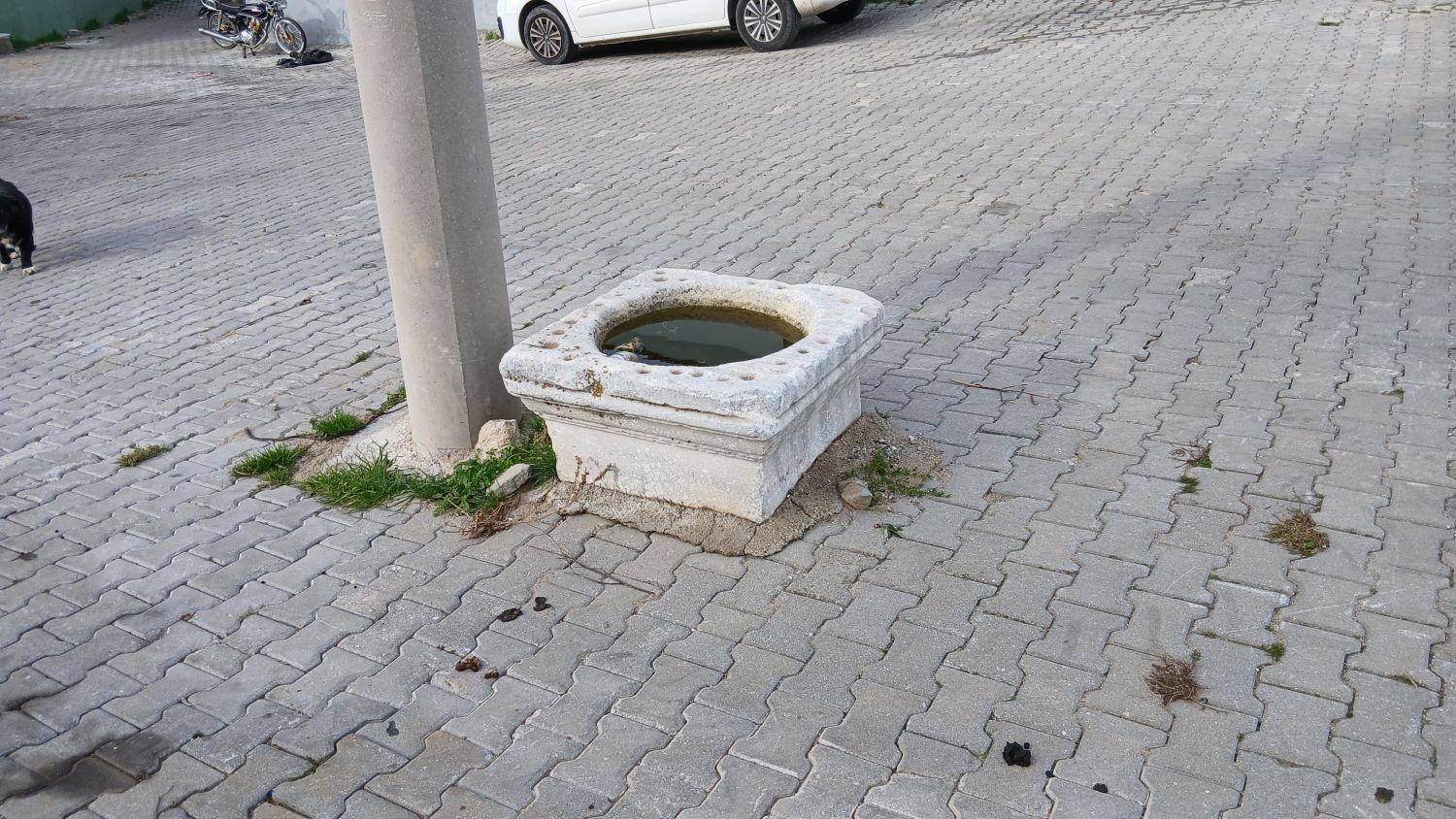
Old Stone in Tavaklı Village Square
In Tavaklı’s village square, beside a modern lamppost and surrounded by everyday village life, sits a carefully carved stone block that has long attracted curiosity. Though it may appear unremarkable at first glance, its shape, workmanship, and material suggest that it once formed part of a much older structure and has likely travelled some distance before arriving at its present location.
Description of the Stone
The stone is square in plan, carved from a single block of pale limestone or marble. At its centre is a circular depression filled with water, surrounded by a raised rim. The upper surface is neatly finished, while the sides display simple moulding, indicating that this was not a crude utilitarian object but a purpose-made architectural element.
The overall form strongly suggests that the stone was originally intended to be seen and used, not buried or hidden. Its craftsmanship indicates skilled stonework rather than ad-hoc carving.
What Might It Have Been?
Based on its form and regional parallels, several possibilities stand out:
1. A Column Base or Pedestal
The circular hollow may have supported the base of a column or post. Such column bases were common in Hellenistic and Roman architecture, particularly in public buildings, courtyards, and porticoes. The square outer form with a circular centre is a familiar design from antiquity.
2. A Fountain or Water Feature Element
Alternatively, the stone may have functioned as part of a small fountain or water basin. In Roman, Byzantine, and later Ottoman contexts, carved stone basins were frequently used in courtyards, public spaces, and religious complexes. The depression could have collected water from a spout or channel above.
3. A Reused Architectural Fragment
It is also possible that the stone had already been reused once before arriving in Tavaklı. Throughout Anatolia, architectural elements from earlier periods were often repurposed in later constructions, particularly during the Byzantine and Ottoman eras.
How Did It Arrive in Tavaklı?
Tavaklı lies within a landscape rich in ancient remains. The nearby site of ancient Larissa and other lesser-known ruins in the Ezine region have, for centuries, supplied building stone to surrounding villages.
Until relatively recently, it was common practice for villagers to retrieve worked stone from abandoned or partially ruined sites for practical use. Such stones were valued for their durability and craftsmanship and were often employed as:
- water troughs
- washing basins
- mounting blocks
- or decorative elements in village squares
The stone in Tavaklı was likely brought here during the late Ottoman or early Republican period, when archaeological awareness was limited and re-use of ancient materials was both practical and accepted.
Its Role in the Village Square
Once placed in the square, the stone appears to have been adapted to a new function. The central depression now holds water, possibly serving at various times as a basin for animals, a convenient water source, or simply a functional object incorporated into daily village life.
Over time, as the original context of the stone was forgotten, it became a familiar but unexplained feature of the square—part of the village landscape rather than a recognised historical artefact.
A Quiet Piece of Tavaklı’s Deep Past
While its precise origin may never be known without archaeological investigation, the stone stands as a reminder of the deep historical layers beneath Tavaklı and its surroundings. It represents a long tradition in Anatolia where ancient structures were not erased but absorbed into everyday life, continuing to serve new purposes long after their original meanings were lost.
Today, the stone remains where it has stood for decades, quietly bridging the ancient world and modern Tavaklı—an unassuming yet powerful link to the region’s distant past.






Leave a Reply