Just a short distance from Ezine (around 7 km) and close to Geyikli (approximately 11 km), Kemallı looks out towards Bozcaada and the Aegean. Kemallı Köyü is one of those villages that seems quiet until you start paying attention to what lies beneath its surface. Ancient stone appears in walls and fields, early Ottoman buildings still anchor the settlement, and one remarkable object once found here now sits thousands of kilometres away in a major European museum.
Kemallı’s story is inseparable from its surroundings. The village lies close to the great ancient city of Alexandria Troas, once one of the most important Roman centres in the region. Roads, quarries, ports and settlements once filled this landscape, and long after the city declined its stone and materials continued to be reused by later communities. Kemallı grew up within this layered world.
A village on older ground

Archaeological surveys around Kemallı have shown that the fields surrounding the village contain material from a Late Roman rural settlement. Pottery fragments, roof tiles, large storage jar pieces and worked stone appear scattered across the land, suggesting sustained activity long before the present village took shape. Parts of this area are now recognised as archaeologically sensitive, reminding us that Kemallı’s past does not sit only in standing buildings, but also quietly beneath the soil.
By the medieval period, the area was drawn into the expansion of Turkish settlement in north-west Anatolia. Local tradition links the foundation of the village to Kemal Bey, a frontier leader of the early Turkish period, and this association still shapes how Kemallı understands its origins today.
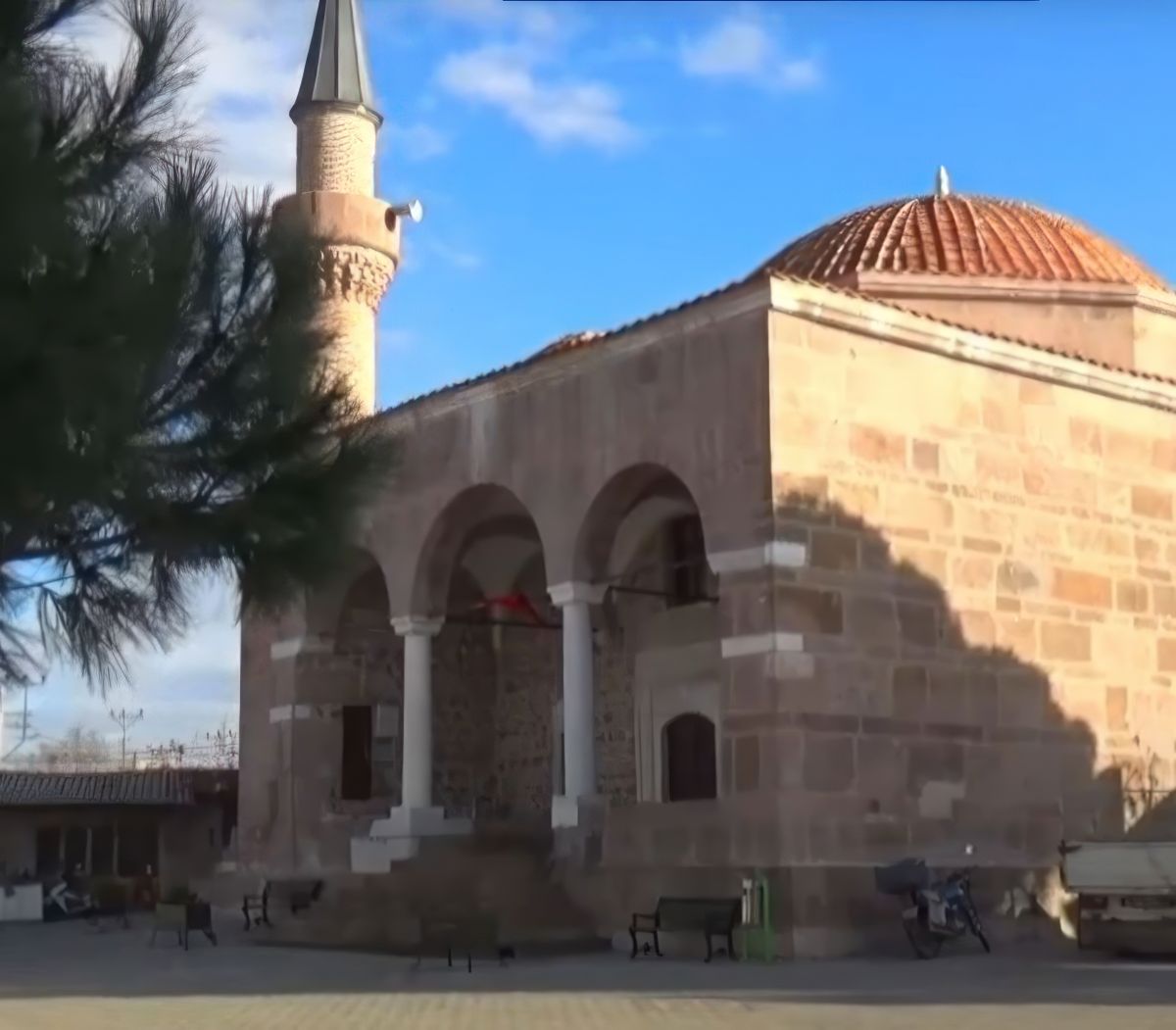
The Asılhan (Aslıhan) Bey Mosque

Kemallı’s most striking building is its mosque, a compact but powerful structure built of carefully cut stone. Generally dated to the 14th century, it belongs to the formative years of Ottoman rule in the region and is associated with Asılhan (or Aslıhan) Bey, traditionally described as Kemal Bey’s son.

The mosque’s architecture reflects both its rural setting and its importance. Thick stone walls, a simple domed interior and restrained decoration give it a solid, almost defensive character. Much of its stonework is believed to have been brought from nearby ancient sites such as Alexandria Troas or Neandria, continuing the long local tradition of reusing earlier materials.
Even today, the mosque feels less like an isolated building and more like the heart of a small historic complex.
Asılhan Bey

Asılhan Bey lived during the early Ottoman period and was active in the late 14th century as a local bey in Kemallı village, near Ezine in Çanakkale Province. His exact birth date is unknown. His death occurred in 1383 CE (H. 785), as recorded on the inscription of his tomb located in the Kemallı Village Cemetery.
An inscription on the Asılhan Bey Camii (also known as the Kemallı Camii) states that the mosque was constructed in 1382 CE (H. 784) during the reign of Sultan Murad I (Murad Hüdavendigâr). These dated inscriptions place Asılhan Bey firmly within the formative phase of Ottoman expansion in western Anatolia during the 1380s. In local historical tradition, he is identified as the son of Kemal Bey, after whom the village of Kemallı is named.
The hamam: a forgotten bathhouse

Close to the mosque stands the village hamam, a modest but historically significant bathhouse. Though no longer in use, it preserves the familiar sequence of spaces: a cold room, a warm room and two small hot rooms, all built in stone and brick beneath domed roofs pierced by light openings.

The hamam fell out of regular use many decades ago, though villagers carried out repairs in the mid-20th century before it was finally abandoned. In recent years it has been formally recognised as a monumental historic building, ensuring that it is now protected and recorded as part of Kemallı’s heritage.
Together with the mosque, the hamam points to a time when Kemallı functioned not just as a collection of houses, but as a small, organised community with shared social and religious spaces.
The türbe and the idea of a village complex
To the north of the mosque is a türbe, reinforcing the impression that Kemallı once had a compact religious and social centre rather than scattered individual structures. While modest in scale, the grouping of mosque, hamam and türbe reflects early Ottoman settlement patterns, where daily life, worship and remembrance were closely linked.
The stone that travelled to Europe

Perhaps the most remarkable chapter in Kemallı’s story concerns a single stone.
In Roman times, a funerary inscription was set up here for a gladiator named Melanippos, praised for his strength and likened to Hercules. At some point in the modern era, this stone left the village. Today, it is held in the Louvre Museum in Paris.
Translation of the Melanippos inscription
(Louvre MA 2911 – from Kemallı, near Alexandria Troas)
“Melanippos, incomparable in strength,
second to none among men,
equal to Herakles.
Having lived bravely,
he lies here.”
What the inscription tells us

- Melanippos was a gladiator, not a soldier or athlete.
- He was admired locally — this is not a mass-produced epitaph, but a personalised memorial.
- Comparing a mortal to Herakles (Hercules) was exceptional and implies:
- physical power
- courage
- and public recognition
- The tone is heroic rather than tragic, suggesting pride rather than shame in his profession.
This kind of inscription fits well with 2nd–3rd century AD Roman funerary language, especially in regions like the Troad where Greek remained the everyday written language even under Roman rule.
This is not simply village folklore. The inscription is well known to scholars, and its origin is firmly recorded as Kemallı, near Alexandria Troas. It is a striking reminder that even the smallest places can be connected to global histories, and that Kemallı once lay within a world where Roman entertainment, violence and fame reached deep into the countryside.
A village shaped by reuse & continuity

Kemallı is best understood not as belonging to a single period, but as a place shaped by continuity. Roman rural settlement gave way to medieval Turkish life; ancient stone found new purposes in mosques and walls; social buildings rose, declined and survived; and one carved stone travelled from a quiet Aegean village to one of Europe’s great museums.
For visitors today, Kemallı offers no grand ruins or ticketed sites. Instead, it offers something subtler and arguably richer: the chance to stand in a living village where history has never really stopped, only changed its shape.
Kemallı Today
Kemallı is a medium-sized rural village in the Ezine district of Çanakkale, rooted in agriculture yet offering a few unexpected and well-designed community features. On the surface it reflects traditional village life, but closer inspection reveals some pleasant surprises. The village has two bakkals located on its outskirts, providing basic daily necessities, while most wider shopping needs are met in nearby Ezine.

Kemallı’s economy is centred on olive oil and dairy production, with several small-scale facilities producing olive oil and Ezine-style cheese, alongside poultry and other agricultural activities. What sets Kemallı apart is its modern, thoughtfully planned village library, which serves as a cultural and educational hub, and an adjoining ceramic workshop.

The Atolye Avlu workshop produces hand-crafted ceramic items, many of which are available for purchase, adding an artistic and cultural dimension that is uncommon for a village of this size. Overall, Kemallı today is a working agricultural village that quietly combines traditional rural life with culture, creativity, and community-focused spaces.
We also visited some of the old Ottoman graves in the cemetery. Taking the information and using AI we were able to read some of the information on 15 of the grave stones that were clear enough. With further research it may be possible to establish a family tree.
To view the details click here






Leave a Reply